What Is Mulberry Silk? Benefits, Quality, and a Practical Buying Guide
Mulberry silk is a natural protein fiber produced by domesticated Bombyx mori silkworms raised primarily on mulberry leaves. It is widely used for fine bedding and clothing because its long filaments can be woven into fabric with a smooth surface, fluid drape, and natural luster.
For a pillowcase, however, “mulberry silk” is only the beginning of the specification. Fiber percentage, momme weight, weave, construction, dimensions, closure, and care instructions all affect the finished product. This guide explains what the term means, the practical benefits you can reasonably expect, and what to check before buying.
What Is Mulberry Silk?
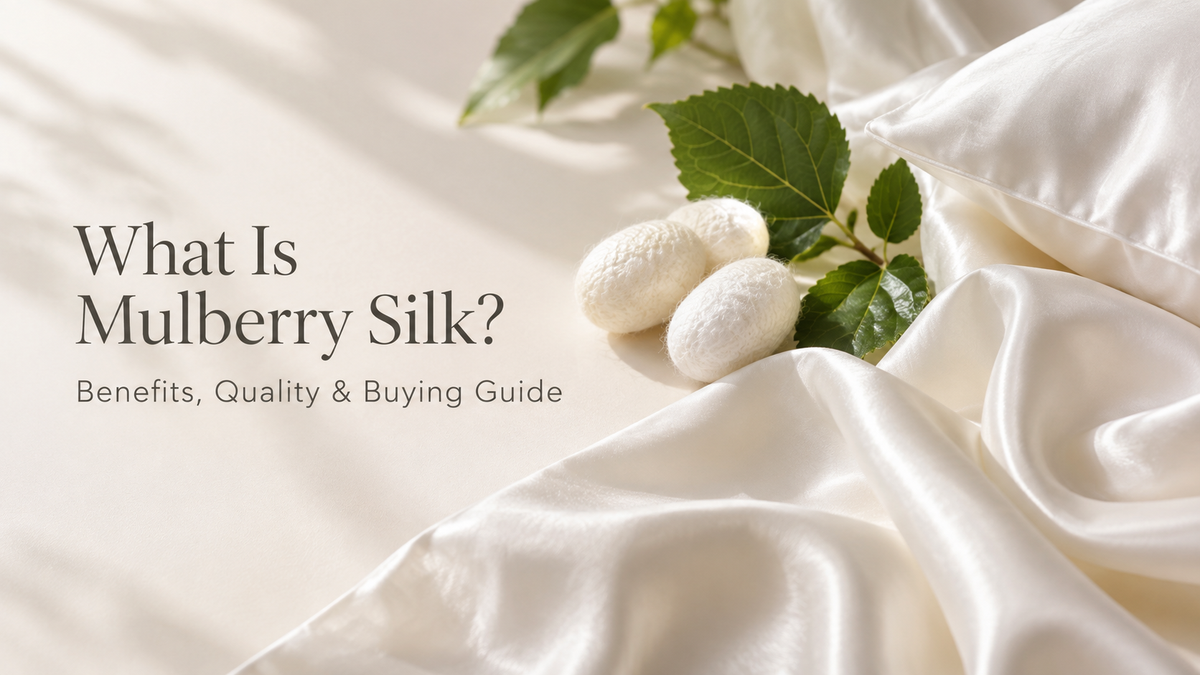
Mulberry silk comes from the domesticated silkworm Bombyx mori. These silkworms are reared in controlled conditions and feed on mulberry leaves. They spin cocoons from fine protein filaments that can be reeled, prepared, and woven into silk fabric.
The term “mulberry” describes the silk’s source. It does not describe the fabric weight, weave, dimensions, or construction of a finished pillowcase. Two products can both use mulberry silk yet feel and perform differently because they use different momme weights, finishes, seams, closures, or materials on the reverse.
The Central Silk Board’s description of mulberry silk identifies Bombyx mori and mulberry leaves as the basis of this silk type.
How Is Mulberry Silk Made?
Mulberry cultivation and silkworm rearing are parts of sericulture. After the silkworm forms its cocoon, the filament is carefully reeled and processed before weaving.
- Mulberry trees are cultivated to provide leaves for the silkworms.
- Bombyx mori silkworms are reared and form cocoons from silk filaments.
- The filaments are reeled and prepared for textile production.
- Sericin is reduced during degumming, revealing the softer fibroin filaments used in finished silk fabric.
- The silk is woven, dyed, finished, cut, and sewn into a product such as a pillowcase.
Each stage affects the result. The fiber source matters, but so do weaving consistency, dyeing, finishing, stitching, and quality control. This is why the words “mulberry silk” alone cannot tell you whether a pillowcase is well made.
Is Mulberry Silk Real Silk?
Yes. Mulberry silk is genuine natural silk. The more useful buying question is whether the finished product is made entirely from it.
Look for a clear fiber-content statement such as “100% mulberry silk.” Words such as “silky,” “silk-like,” and “satin” do not confirm that a product contains silk. Satin is a weave and can be made from silk, polyester, or other fibers.
For products sold in the United States, the FTC Textile Fiber Rule requires covered textiles to disclose their constituent fibers and percentages by weight. The product label is therefore more useful than a decorative marketing phrase.
For a more detailed explanation, see our guide to silk vs satin pillowcases.
What Are the Benefits of Mulberry Silk?
The most defensible benefits of mulberry silk are practical and sensory: its smooth surface, light drape, natural luster, and comfortable feel. The exact experience depends on how the silk is woven and finished.
A smooth, low-friction surface
Fine silk filaments can create a smooth textile surface. When used for a pillowcase, this can allow hair and skin to move across the fabric with less catching than they might experience against a rougher surface. It is reasonable to describe silk as feeling gentler or helping reduce pulling; it is not reasonable to promise that a pillowcase will prevent every tangle or stop hair breakage.
A soft and refined hand feel
Silk combines softness with a fluid drape. It settles around a pillow rather than feeling stiff, while its surface reflects light across folds. These characteristics are a major part of why people choose silk for bedding.
Comfort with moisture and temperature changes
Silk is hygroscopic, meaning it can take up moisture from the surrounding air. In practical use, many people find silk comfortable across changing seasons. Still, no pillowcase controls an entire sleep environment: weave, momme weight, room temperature, humidity, bedding layers, and individual preference also matter.
A natural fiber option
Mulberry silk suits shoppers who prefer a natural protein fiber rather than a synthetic satin surface. This is a material preference, not proof that every silk product is automatically better than every synthetic one.
A consistent surface when used on both sides
If both exterior faces of a pillowcase are made from silk, either side can be placed upward. “Mulberry silk” does not automatically confirm this construction, so check whether the listing explicitly says silk is used on both sides. Our guide to double-sided silk pillowcases explains the difference.
What Does Mulberry Silk Mean for Hair and Skin?
For hair and skin, the useful feature is the smooth textile surface. Lower surface friction may help reduce pulling as you change position during sleep, and the fabric may feel gentler against the face than a rougher textile.
Results vary with hair type, skin condition, fabric construction, washing, and the rest of a person’s routine. A silk pillowcase does not treat acne, eczema, wrinkles, hair loss, or another medical condition. Clean bedding and appropriate personal or medical care remain more important than the fiber name alone.
When comparing products, concentrate on qualities that can be checked: fiber content, fabric weight, surface condition, construction, size, closure, and care.
Is Mulberry Silk Breathable?
Silk fabric can feel light, breathable, and comfortable, but “breathability” is not determined by fiber alone. The weave density, momme weight, finish, pillow protector, and other bedding layers influence airflow and temperature feel.
A smooth surface may feel cool at first contact. That does not mean silk actively cools every sleeper throughout the night. People who sleep warm should consider the whole bedding system and room conditions rather than expecting one pillowcase to change their temperature by itself.
Mulberry Silk, Momme, Satin, and Grade 6A
These terms answer different questions. Keeping them separate makes product descriptions much easier to understand.
| Term | What it describes | What it does not prove |
|---|---|---|
| Mulberry silk | The silk source, associated with Bombyx mori and mulberry leaves | Fabric weight, finished size, or double-sided construction |
| 100% silk | The stated fiber composition | Momme weight, sewing quality, or closure type |
| Momme | Silk fabric weight | Fiber source or overall product quality |
| Satin | A weave with a smooth face | That the fiber is silk |
| Grade 6A | A supplier description of raw-silk quality | The quality of every later production stage |
| Double-sided | The construction of the two exterior faces | Fiber composition unless it is stated separately |
Momme is especially useful when comparing similar silk products. A 22 momme pillowcase contains more silk by weight for the same fabric area than a 19 momme pillowcase, but both can be genuine silk. Read our 19 vs 22 momme comparison for the practical differences.
How to Choose a Mulberry Silk Pillowcase
A useful product listing should answer the following questions clearly:
- Fiber content: Does it state 100% mulberry silk?
- Fabric weight: Is the momme value disclosed?
- Construction: Is silk used on both exterior sides or only one?
- Size: Are exact dimensions given in inches or centimeters?
- Closure: Does it use a hidden zipper or envelope opening?
- Quantity: Does the package contain one pillowcase or a pair?
- Care: Are the washing and drying instructions clear?
- Current options: Are your preferred size and color available?
Judge these specifications together. A glossy image or a single grade label cannot replace a complete product description.

MUSE & AIRY
22 Momme Mulberry Silk Pillowcase
Queen · 20 × 30 in / 51 × 76 cm
Pearl White · Silver Gray · Champagne
Includes one pillowcase. Pillow insert not included.
Shop the Pillowcase →Choose your color and view current pricing.
How to Care for Mulberry Silk
Always follow the sewn-in care label because dyes, finishes, and construction vary. For the current Muse & Airy pillowcase, the recommended method is a brief hand wash in cool water no warmer than 30°C / 86°F with a mild, pH-neutral detergent formulated for silk.
- Do not bleach, soak, scrub, or wring.
- Support wet silk rather than lifting it by one corner.
- Press out moisture gently with a clean towel.
- Reshape and dry flat in the shade.
- Avoid tumble drying and concentrated heat.
Our step-by-step guide explains how to wash a 22 momme silk pillowcase.
Frequently Asked Questions
Is mulberry silk real silk?
Yes. Mulberry silk is genuine silk produced by domesticated Bombyx mori silkworms. Check the fiber-content label to confirm that the finished product is 100% silk rather than a blend.
Is all silk mulberry silk?
No. Mulberry silk is one type of silk. Other silks are produced by different silkworm species and rearing systems.
Is mulberry silk the same as satin?
No. Mulberry silk identifies a fiber source; satin identifies a weave. Satin may be woven from silk, polyester, or another fiber.
Is mulberry silk hypoallergenic?
“Hypoallergenic” is not a guarantee that a material will cause no reaction. People with allergies or sensitive skin should assess their individual needs and the complete product, including dyes and finishes.
Does mulberry silk prevent wrinkles or acne?
No pillowcase should be presented as a treatment or guaranteed prevention for wrinkles, acne, eczema, or another medical condition. Silk offers a smooth contact surface, but skincare, hygiene, health, and individual factors remain important.
Is a higher momme always better?
No. Higher momme means more silk weight for the same fabric area. The preferred weight depends on feel, use, budget, construction, and care; it does not replace an assessment of the whole product.
How can I tell whether a pillowcase uses silk on both sides?
Look for an explicit statement that both exterior faces are made from silk. The phrase “mulberry silk pillowcase” alone does not confirm double-sided construction.
What Matters Most
Mulberry silk is a genuine natural silk known for its fine filaments, smooth surface, fluid drape, and luster. For a pillowcase, its most practical appeal is a soft, low-friction sleeping surface and a refined feel.
The strongest purchase decision comes from reading beyond the product name. Confirm the fiber percentage, momme weight, materials on both sides, exact dimensions, closure, quantity, and care instructions. Those details explain far more about the finished pillowcase than shine alone.
Reviewed against information from the Central Silk Board, the U.S. Federal Trade Commission’s textile-labeling guidance, and the current Muse & Airy product and care specifications.